
Pulsar glitches
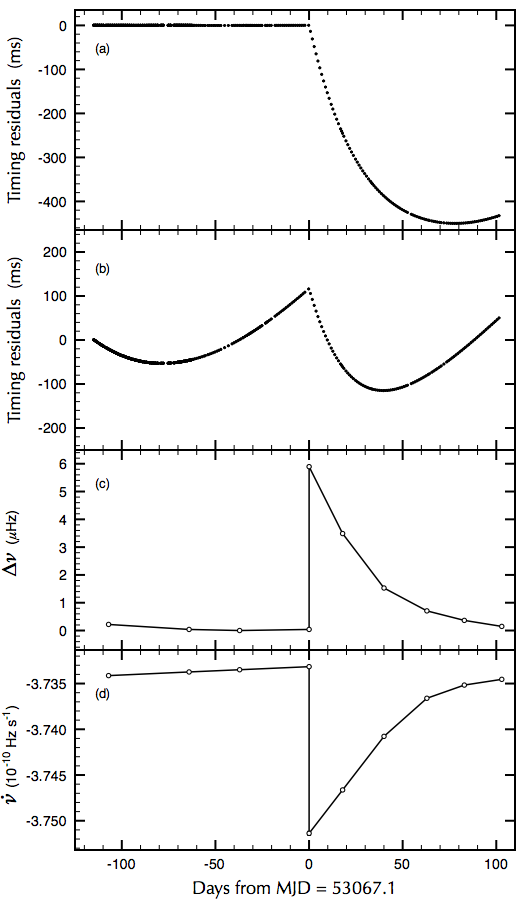
A glitch in the data of the Crab pulsar. It occurred in March 2003 and is the largest detected glitch on this pulsar. However, it is small compared to the glitches observed in Vela-like pulsar, which are about 1,000 times larger. Check the paper for more details.
Pulsars are famous for their very stable rotation, provided by their high density and rapid spin. Pulsar timing, the method by which the rotation of pulsars is measured and described, is a high precision discipline. This accuracy makes it possible to detect and measure very small perturbations affecting the normal rotation of the star.
Glitches are rare events of very short duration, seen in the data as sudden jumps in rotational frequency. Following a glitch, the pulsar sometimes enters a stage of recovery, in which the rotation frequency decays towards the pre-glitch value.
- Glitch Catalogue
-
The catalogue contains basic glitch information on all published glitches plus regularly updated detections using the Lovell telescope at Jodrell Bank Observatory (view the table).
- For each glitch, its epoch and the frequency and frequency derivative fractional steps are given. Epochs are given in Modified Julian Days (MJD), frequency fractional steps are given in units of 10-9 and frequency derivative fractional steps in units of 10-3. The last column of the table indicates the origin of the values and whether the glitch appears in other publications.
- Unless otherwise stated in the last column, values in the table are estimated as described in Espinoza et al. (2011).
- You can also access the original table from the paper. This (online) version includes two extra columns containing the frequency jumps (in micro Hz) used for the calculations in the paper and the frequency derivative jumps (in units of 10-15 Hz s-1).
- We use the definition of glitch given in Espinoza et al. (2011).
Should you have comments, questions or suggestions, please contact Cristóbal Espinoza
(cespinoz -at- astro.puc.cl).Please refer to Espinoza et al. (2011)
and the url http://www.jb.man.ac.uk/pulsar/glitches.html
when using this data for publications.

