How do planets change across the Milky Way?
Almost everything we know about exoplanets comes from stars close to the Sun. My research aims to move from that local snapshot to a predictive, Galaxy-wide account of planetary populations — across the disc, the bulge and the far side of the Milky Way — and to use their dependence on host star and Galactic environment as a direct test of how planets form and evolve.
Towards a predictive map of planetary populations
NASA's Roman Space Telescope will, for the first time, apply two complementary techniques — gravitational microlensing and transits — to the same stellar populations, sampled over comparable Galactic distances. Microlensing is most sensitive to cool planets on wide orbits; transits to hot planets on close orbits. Together they cover the full architecture of planetary systems.
Combining them in a single, rigorous statistical framework will do more than produce a larger catalogue. It will connect planet populations to the stars and Galactic environments in which they formed, test how occurrence depends on host-star mass, the ice line and migration, and distinguish truly free-floating planets from those on very wide orbits. The goal is a framework that can predict what different surveys should see anywhere in the Galaxy and use the observations to refine the underlying population model.
- ESA-appointed scientist, NASA Roman Galactic Exoplanet Survey (the sole ESA appointee to the Galactic Bulge Time Domain Survey)
- Member, Roman Galactic Exoplanet Survey Project Infrastructure Team (RGES-PIT)
- Lead, Demographics Working Group, Transits in the Roman Exoplanet Survey (TRExS)
- Former lead, ESA Euclid Exoplanet Science Working Group (2023–2025). Led the group during development, commissioning and execution phases of the Euclid Galactic Bulge Survey
- Originator and team leader for the Manchester–Besançon Microlensing Simulator (MaBμlS)
NASA Nancy Grace Roman Space Telescope
Roman's Galactic Bulge Time Domain Survey will monitor hundreds of millions of stars towards the centre of the Milky Way. I contribute to its Galactic Exoplanet Survey and lead the demographics effort within its transit science team.
- Roman is expected to find ~1,400 cool exoplanets by microlensing, down to the mass of Mars (Penny et al. 2019).
- It is also expected to discover 60,000–200,000 transiting exoplanets over Galactic distances (Wilson et al. 2023).
- My focus: combining both samples within a common Galactic framework, so that the full architecture of planetary systems can be compared across host stars and environments.
ESA Euclid Galactic Bulge Survey
As lead for the Euclid Exoplanet Science Working Group between 2023-25 I pushed the science case for the Euclid Galactic Bulge Survey to Euclid and ESA colleagues, and led the team through the survey development, commissioning and execution phases. Euclid's sharp, wide-field imaging provides an earlier epoch and a complementary view of the same fields as NASA Roman — magnifying what Roman can learn about each planet and its host star.
- White paper: Magnifying NASA Roman GBTDS exoplanet science with coordinated observations by ESA Euclid.
- The survey was successfully executed in March 2025. In June 2026 the team published the widest high-resolution view yet of the Galaxy's central regions (Beaulieu et al. 2026), which was covered by The Guardian and other outlets.
Kepler K2: the first space-based microlensing survey
In 2016 NASA's Kepler spacecraft, in its K2 mission, stared at the Galactic bulge — the first space-based survey designed to find planets by microlensing. My group led the analysis.
- 27 candidate short-duration events, including candidates for free-floating, Earth-mass planets (McDonald et al. 2021).
- K2-2016-BLG-0005Lb — the first confirmed exoplanet discovered from space using gravitational lensing, a near-twin of Jupiter ~17,000 light-years away (Specht et al. 2023).
MaBμlS — Manchester–Besançon Microlensing Simulator
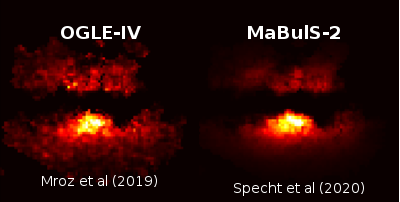
MaBμlS combines the Besançon model of the Milky Way with detailed microlensing physics to predict event rates and properties across the sky. It provides the bridge between a physical model of the Galaxy and the events a survey will actually detect, and has been calibrated against observations and used by ESA and NASA teams to design and optimise space-based surveys.
SPEARNET — exoplanet atmospheres
An automated approach to choosing exoplanets for atmospheric study can allow us to gather statistical samples whose population completeness is understood. Normally, large telescopes are used to study exoplanet atmospheres, but there are few such telescopes. SPEARNET is pioneering an alternative approach - automated selection of exoplanet targets using the collective light-gathering power of globally distributed networks of telescopes of differing capability. We have developed our own code, TransitFit, to fit multi-telescope, multi-epoch, multi-wavelength data for atmospheric and timing studies. We are applying our tools to ground and space-based observations from telescopes as small as 20cm aperture all the way to 8m-class telescopes such as the VLT and James Webb Space Telescope. Our tools allow us to combine all such observations and treat them as a single dataset for consistent timing and atmospheric modelling.
Mutual Detectability — a SETI strategy
Where should we look for other civilisations? Framing the search for extra-terrestrial intelligence (SETI) as a Schelling coordination game, Mutual Detectability argues for prioritising systems from which Earth itself can be observed using similar methods. The more we see of each other the more evidence we uncover of our mutual existence — a strong incentive for one side or the other to attempt contact. One example is to focus on habitable zone transiting planets from which Earth itself can be seen transiting the Sun. The transit method is especially useful in looking for indications of life, potentially even technosignatures, in the atmospheres of planets. If there are observers on our target world, the more we observe each other's planet the greater the chance of finding evidence for life, even inteligent life. Crucially, both they and us will know that the other can potentially gather similar evidence. We can even easily work out who has the clearer signal of the other - maybe they are the party most motivated to send a message? Mutual Detectability is an example of a coordination game between two non-communicating participants, rather like the famous problem of strangers trying to meet up in New York. The Mutual Detectability strategy can't gaurantee success, but it can massively improve the odds. The work on Mutual Detectability drew international coverage in Physics World, Astronomy, Discover and National Geographic.